Florence’s messiest genius rivalry, staged like a couture deathmatch
Florence, circa 1504, wasn’t just making art. It was making power; and it wanted that power painted ten meters tall on a wall where politics could admire itself.
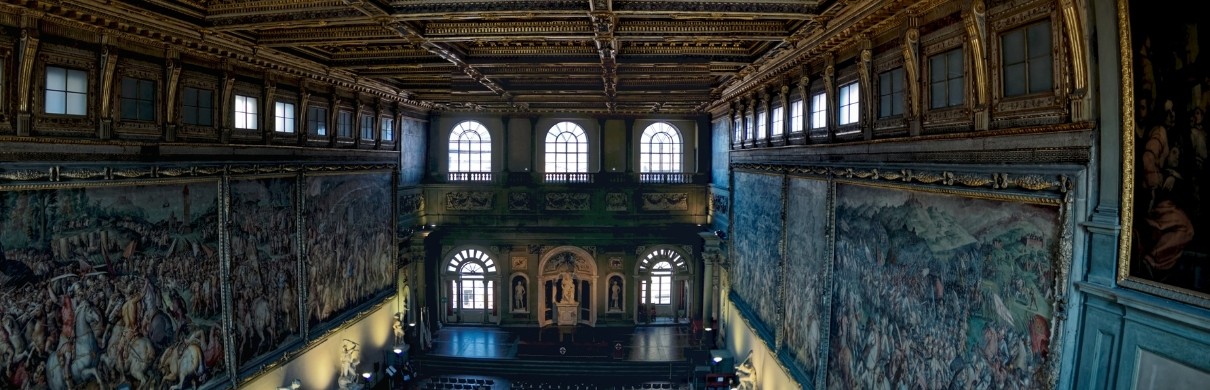
So the Republic set the scene inside the Palazzo Vecchio’s great council hall (the Salone dei Cinquecento): Leonardo da Vinci on one wall, Michelangelo on the other; two battle murals commissioned as propaganda for civic glory. ([Wikipedia][1]) This is the closest the Renaissance ever got to a runway-style face-off: same room, same city, same pressure, maximum spectators.
And the delicious part? Neither mural was finished. ([Wikipedia][1])
It’s the most iconic “unreleased collection” in Western art history.
Leonardo was commissioned (under Florentine leader Piero Soderini; accounts note the contract was signed by Niccolò Machiavelli) to paint The Battle of Anghiari; a Florentine victory, rendered as a knot of horses and men fighting for a standard. ([Wikipedia][1]) Michelangelo was commissioned to paint The Battle of Cascina, another Florentine victory, his version centering on bodies in motion, soldiers caught bathing, then snapping into violence like a trap springing. ([Wikipedia][2])
If you’re wondering why this rivalry hits different, it’s because it wasn’t just “two famous artists competing.” It was two incompatible philosophies forced to share oxygen.
Leonardo is the cool one at the party: optics, atmosphere, the half-smile that implies he knows something you don’t. He builds feeling through fog: sfumato, suggestion, intelligence as seduction. ([The Guardian][3])
Michelangelo is the one who is the earthquake: the body as theology, muscle as prophecy, tension carved into existence. ([The Guardian][3])
And yes, there’s gossip. There are anecdotes of public sniping and disdain (a lot of them filtered through Vasari and later retellings), but even serious historians warn that direct evidence of their interactions is scarce and that legend fills the gaps. ([The Guardian][4]) Rivalry, in other words, is partly document, partly myth, and partly the simplest truth: when two suns share a sky, everyone stares, waiting for the eclipse.
Then the commissions collapsed the way grand plans often do.
Michelangelo left Florence for Rome in 1505, pulled into papal orbit (projects, tombs, bigger forces than the Republic’s pride) leaving behind a cartoon that would be copied, coveted, and eventually damaged and dispersed. ([Wikipedia][2]) Leonardo struggled with execution too; the Anghiari project was never completed, surviving in studies and later copies that let us glimpse the violence he was aiming for. ([Wikipedia][1])
So what’s the point of a rivalry where the “main event” never happened?
Because the real event wasn’t paint on plaster. It was Florence watching two definitions of greatness collide: the intellectual-poet engineer versus the obsessive sculptor-mystic, and realizing art could be a battleground of identity.
THE VERDICT
Leonardo makes you believe beauty is a secret.
Michelangelo makes you believe beauty is a fight.
And Florence? Florence simply did what it always does: it turned genius into spectacle, rivalry into legend, and unfinished work into immortality.
[1]: https://en.wikipedia.org/wiki/The_Battle_of_Anghiari_%28Leonardo%29 "The Battle of Anghiari (Leonardo)"
[2]: https://en.wikipedia.org/wiki/Battle_of_Cascina_%28Michelangelo%29 "Battle of Cascina (Michelangelo)"
[3]: https://www.theguardian.com/artanddesign/2024/nov/09/leonardo-raphael-michelangelo-royal-academy "Leonardo, Raphael and Michelangelo: who is the greatest of the Renaissance masters?"
[4]: https://www.theguardian.com/culture/2024/sep/29/the-new-wolf-hall-bitter-rivalries-in-renaissance-florence-coming-to-bbc "The new Wolf Hall? Bitter rivalries in Renaissance Florence coming to BBC"